Negative splits
Running taught me that going out slower is not caution. It is arithmetic — and it applies to shipping software too.
A negative split means running the second half of a race faster than the first. Every world record at the marathon distance in the last two decades has been run this way. Almost every amateur does the opposite.
The reason is not fitness. It is that the first ten kilometres feel free.
The feeling is the trap
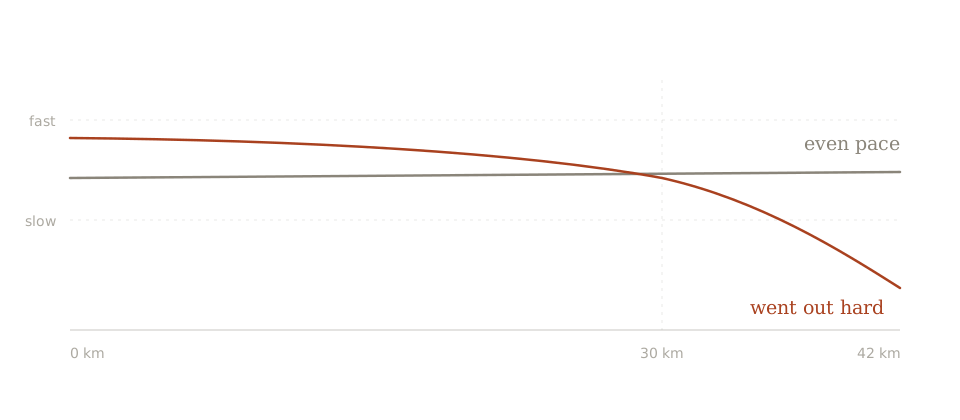
Early in a race you have rested legs, fresh glycogen and a crowd. The pace that feels comfortable is meaningfully faster than the pace you can hold, and there is no signal at the time to tell you that. The bill arrives at kilometre thirty, in full, with interest.
| Strategy | First half | Second half | Finish |
|---|---|---|---|
| Went out hard | 1:28 | 1:41 | 3:09 |
| Even | 1:33 | 1:33 | 3:06 |
| Negative | 1:34 | 1:30 | 3:04 |
Every one of those rows describes the same fitness. The only variable is how the effort was distributed, and it is worth five minutes.
The same shape, in a project
I have watched this play out on every project I have been part of. The first two weeks feel free. There is no legacy code, no users, no support load — so the pace we set feels sustainable, and we plan the rest of the timeline as though it is.
Then the bill arrives:
- the shortcuts taken in week one become the thing everyone routes around
- the tests skipped to keep pace become the reason nobody refactors
- the “we will document it later” becomes the onboarding cost for every new person
None of these are visible while you are running the first half fast. They are all fully visible from kilometre thirty.
What I actually changed
I did not get more disciplined, because discipline is not a plan. I changed one mechanical thing in each case.
In running, I put the target pace on my watch and refuse to look at anyone else for the first hour.
In work, I hold the first week to the same output as a normal week — no heroics, no late nights, nothing that cannot be repeated forty times. If the schedule does not survive that constraint, the schedule was fiction, and it is much cheaper to find out in week one than in week nine.
The uncomfortable part is that going out slower feels like underperforming for about half the distance. You have to be willing to be passed by people you will later pass. That is the whole skill, and I am still not especially good at it.
Newsletter
Told you something useful?
New essays, sent when they are finished. No schedule, no filler.